
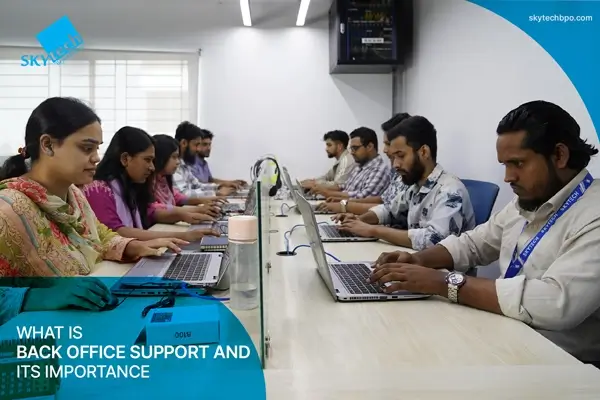
Back office support operations refer to all the behind-the-scenes work that keeps a business running smoothly. These include finance, IT, HR, logistics, and legal compliance tasks essential for daily continuity but not directly involved with customers.
These tasks don’t deal with customers directly, but they’re just as important. A 2024 Deloitte report shows that over 80% of companies now outsource at least one back office job to save money and work faster.
With more businesses going digital and growing quickly, back office support has become a key part of staying organized and efficient.
In this article, I will talk about the key types of back office services, their benefits, importance, and how outsourcing them can impact business performance across industries. Understanding these foundations is essential in an economy where speed, efficiency, and scale define competitiveness.
Now let’s break down the core elements and advantages of back office support.

Back office support refers to the internal processes that help a business run smoothly, without directly dealing with customers.
It includes essential tasks like managing company finances, handling payroll, maintaining employee records, processing data, and keeping IT systems functional. These activities may not be visible to customers, but they are the foundation of a business’s daily operations.
For example, while sales teams are focused on meeting clients, the back office ensures invoices are sent, suppliers are paid on time, and internal systems are secure. Without this support, the front-facing parts of a business would quickly become inefficient.
Many companies now use automation and outsourcing to handle back office functions more efficiently. This allows their core teams to focus on business growth, product development, and customer experience. According to a Deloitte report from 2023, 72% of companies reported higher productivity after investing in smarter back office solutions.
Even though it works behind the scenes, strong back office support helps reduce mistakes, save money, and improve decision-making, making it one of the most important drivers of long-term business success.

Back office support includes various functions that ensure operations run without disruption.
These back office functions are often divided into categories based on their role within the organization. Below are the most common and essential types of back office support functions.
Administrative support covers a broad range of tasks that help maintain business productivity.
This includes managing calendars, scheduling meetings, processing documents, organizing files, and data entry.
Virtual assistants and remote administrative teams have become a popular choice for handling these tasks efficiently. By outsourcing these roles, companies save time and reduce internal workload without sacrificing quality or speed.
Finance and accounting are among the most critical parts of the back office.
These teams handle bookkeeping, budget planning, tax filing, invoice processing, payroll, and financial reporting. Errors in financial management can lead to compliance issues or cash flow problems.
That’s why many companies rely on professional accounting services or cloud accounting software to maintain accurate records. According to PwC, companies that outsource finance tasks cut costs by up to 30% on average.
IT support maintains the technology infrastructure needed for daily business operations.
From managing servers and networks to troubleshooting computer issues and ensuring cybersecurity, IT plays a vital role.
With remote work increasing, businesses are investing more in outsourced IT solutions. A Statista report shows that global spending on IT outsourcing reached $460 billion in 2023, indicating strong demand for reliable IT partners.
Supply chain or operations management is another important back office function.
It involves tracking inventory, managing suppliers, processing orders, and handling logistics. Efficient supply chain operations lead to faster delivery times and fewer stockouts.
In industries like retail or manufacturing, having a well-structured back office chain management team is key to maintaining profit margins and customer satisfaction.
While customer service is often seen as front office, many support tasks happen behind the scenes.
These include ticket tracking, CRM management, customer data processing, and follow-up automation. With AI-powered chatbots and helpdesk software, many businesses now streamline these backend customer service operations to improve response times and overall experience.
HR support involves recruitment, onboarding, employee data management, benefits administration, and compliance with labor laws.
Companies often use HR outsourcing or software like BambooHR and Gusto to simplify these functions.
Efficient HR support improves employee satisfaction and reduces turnover. Gallup reports that businesses with strong HR processes see 27% less absenteeism and 24% lower turnover.
Back office legal support helps companies meet regulatory requirements and minimize legal risks.
This includes contract management, document reviews, policy updates, and data protection compliance.
Businesses operating across multiple regions especially need robust legal and compliance functions. Outsourcing these roles ensures expertise without hiring full-time legal staff, which can be expensive.

Outsourcing back office support helps businesses do more in less time with fewer costs. It gives access to experts, tools, and systems without hiring a full internal team.
Here’s how it adds real value to your business operations.
When you outsource, work doesn’t pile up. Tasks are done on time because the service provider has a team dedicated to specific jobs. They use advanced tools and automation to finish work faster than an in-house team struggling with multitasking.
For example, a UK-based startup reported 45% faster invoice processing after they outsourced to a finance BPO firm. Speed like this means your business can focus on results, not paperwork.
Hiring full-time employees means paying salaries, benefits, office space, and training costs. Outsourcing avoids all that. You only pay for what you need.
A report by Clutch found that small businesses save up to 60% by outsourcing tasks like IT, HR, or accounting. That’s money that can be used to grow your business or invest in other important areas.
Professional outsourcing teams specialize in what they do. Whether it’s data entry, payroll, or customer service, they follow proper systems to avoid errors.
Mistakes in back office work cost money and hurt your reputation. A 2022 IBM report revealed that businesses lose an average of $3.1 million per year due to poor data quality. Outsourcing cuts down those risks because trained people handle the work carefully.
When your business grows fast, hiring new people quickly becomes a problem. It takes time to find, train, and set up new employees.
Outsourcing companies are built to scale. They can add more people to your project within days. You don’t have to worry about finding office space or laptops, they handle it all. That way, you stay focused on growth, not HR problems.
Your customers don’t care how your back office works, but they feel the result.
When things are organized behind the scenes, your front-end service improves. Orders are processed faster. Support tickets are answered on time. Deliveries don’t get delayed. All of this makes your customers trust your brand more.
A report from Salesforce showed that 84% of customers say the experience a company provides is just as important as its products or services. Strong back office support plays a big part in that experience.
Back office support is like the backbone of your company. It’s not flashy and people don’t talk about it much, but without it, everything starts to fall apart.
It’s what keeps the business running from the inside. If your admin team isn’t handling tasks right or the accounts team messes up payroll, then even the best front-end efforts won’t work.
You might be doing great with marketing or closing deals, but if the back-end is slow or messy, customers will still leave unhappy.
Let’s break down why back office support is so important for any business.
Every business needs a base to stand on, and that’s exactly what back office gives.
Things like managing bills, handling employee records, running software, and setting up daily systems all build the foundation. It’s boring work sometimes, but if it’s not done, nothing else can function properly.
It’s like building a house without laying the base, and one strong wind, and it’s gone.
Back office builds that base so everything else stays in place.
You can’t run a business well if every task takes too long or gets stuck in someone’s inbox. Back office work helps the business move smoothly.
It keeps tasks organized, makes sure people know what to do, and keeps departments connected. Your team won’t waste time chasing files or fixing errors because the back office already handled it.
When this part works well, the whole business works faster and better.
A clean backend means your team has more time to focus on important things, not fixing small messes all day.
Most businesses today depend on data. Your customer names, inventory, sales reports, or employee info are all data. And if that data is wrong, then decisions based on it will also be wrong.
The back office makes sure your data is updated, stored properly, and safe. They use the right tools to keep it clean and easy to access. If you don’t manage your data well, things fall apart slowly, your emails go to the wrong people, your reports show wrong numbers, or you pay wrong salaries.
That’s why this job is more serious than people think.
Stuff goes wrong sometimes. Servers crash, people leave, software breaks, it happens.
But if your back office team has a plan, things won’t stop.
They make backups, create systems, and help the company keep moving even when problems come up. When COVID hit, a lot of companies who had no backup plans couldn’t keep going.
The ones with solid back office systems? They found ways to survive and stay active.
Front office gets the spotlight, sales, marketing, and customer service. But all of them depend on what happens in the back.
Your sales guy can’t close a deal if finance didn’t update the pricing. Your support team can’t help a customer if the ticket system is down. Marketing can’t run campaigns if data isn’t ready. That’s all back office work.
They don’t talk to customers, but they make sure the people who do can actually do their jobs right. So when the back office is strong, your front-end becomes more powerful too.
There are key signs that tell you it’s time to get help from outside. Outsourcing doesn’t mean you’re not capable. It just means you’re smart with time and money.
Let’s go through the situations where outsourcing makes sense.
Your real goal is to grow the business, serve customers, and make profits. Back office tasks are important, but they take up too much time. Outsourcing helps you get back to your main work while others handle the routine stuff.
Hiring full-time staff, training them, and buying software adds up. Many businesses realize that outsourcing is not only cheaper, but also better in quality. You save on salaries, benefits, and overhead without losing efficiency.
Maybe you’re not an expert in accounting or IT. Maybe you don’t have software for HR or legal tasks. Instead of struggling or risking errors, it’s better to let experts do it. They already have the tools, training, and systems in place.
When business grows fast, it brings more work. If your internal team is already full, outsourcing gives you quick backup. You can increase capacity in days, not months.
This is useful in seasonal businesses too, like eCommerce during Eid or Christmas sales. Temporary support from outsourcing teams helps you handle the spike easily.
Time is money. Customers don’t wait, and errors cause problems. If you notice tasks taking too long or getting done wrong, it’s a sign. Outsourcing to a skilled team brings more speed and accuracy.

Choosing the right outsourcing partner can make or break your back office success. It’s not just about finding the cheapest option, it’s about trust, skill, and long-term results.
Here’s what you should consider before hiring a back office support company.
A good provider should feel like an extension of your team. You want someone who understands your goals, respects your workflow, and delivers consistent quality.
Always check how long they’ve been in the business and who they’ve worked with. A company with experience in your industry already knows your challenges and can solve them faster. Ask for case studies or client feedback to see if they actually deliver what they promise.
For example, a BPO that’s handles finance tasks for eCommerce brands will likely understand fast-paced invoice handling better than a general firm.
You’re trusting them with sensitive business data, customer records, payroll, and legal documents. So, security is a must.
Make sure they follow strong data protection policies and industry compliance standards. For example, if you’re in Europe, GDPR compliance is important. If you’re handling US customers, SOC 2 or HIPAA may apply.
Don’t be afraid to ask how they store data, who has access, and how often they update their systems.
Outsourcing works best when communication is clear and easy. You don’t want to keep chasing them to get updates.
Look for providers who assign you a dedicated account manager, give regular updates, and use tools like Slack, Trello, or email to stay in touch. Good service means no surprises and you should always know what’s going on.
Cheap isn’t always better, and expensive doesn’t mean high quality. Make sure the pricing matches the value they offer.
Also check if they can grow with you. Today you might need two people. In six months, you might need ten. A good provider should have flexible plans so you can scale up or down without trouble.
Back office support makes sure everything inside your business works properly, even if no one sees it directly.
It keeps your business steady when you try to grow fast. If your operations, finance, or HR are not in place, your growth can fall apart very quickly. No matter how strong your front office is, without solid support in the back, it can’t go far.
When your customer base increases, your internal work also grows. More orders mean more billing. More employees mean more HR tasks. More clients mean more documents, records, and compliance. This is where your back office takes control and keeps everything in order.
It gives your front-line teams the space to focus. They don’t need to worry about admin, reports, or tech issues. That means faster response, better decisions, and a smoother customer journey.
A study by Deloitte showed that companies with well-structured back office systems are 33% more likely to scale successfully without delays or breakdowns.
Front office and back office roles serve different parts of a business, but both are equally important.
The front office handles all the customer-facing tasks. This includes sales, service, and anything that directly interacts with clients.
On the other hand, the back office works behind the scenes to support those front-end teams. Without the back office, nothing stays organized or on time.
Here’s a simple table to help you understand how they compare:
| Feature | Front Office | Back Office |
| Main Role | Customer-facing activities | Internal operations and support |
| Team Examples | Sales, marketing, customer service | HR, finance, IT, legal, admin |
| Direct Customer Contact | Yes | No |
| Key Goal | Increase revenue and client satisfaction | Keep operations smooth and error-free |
| Impact on Customer | Direct (sales calls, support, feedback) | Indirect (billing accuracy, delivery speed) |
| Tools Often Used | CRM, live chat, email marketing platforms | ERP, accounting software, HRMS tools |
| Success Depends On | Strong processes and fast service | Accuracy, compliance, and consistency |
While they do different jobs, they rely on each other to make the business work. If your front office is closing deals but the back office can’t process orders fast, your customers get unhappy.
If your back office runs well but you don’t have good sales or support, revenue stops coming in.
Many businesses now use shared systems where both teams work together. Tools like Zoho, HubSpot, or Salesforce let front and back office staff update customer info in real time, which helps avoid confusion and delays.
Back office support is changing fast, thanks to technology and remote work.
In the past, back office teams worked from the same office. Now, most companies are switching to virtual assistants, cloud platforms, and outsourced teams from different countries.
Automation is also transforming how tasks are done. Software now handles invoice processing, payroll, and even parts of customer service. A report from McKinsey says that 45% of current back office jobs could be automated with existing tools.
But that doesn’t mean people will disappear. Instead, the human role is shifting to decision-making, supervision, and handling exceptions that tech can’t manage.
In the next few years, we’ll see more AI-driven platforms, better data security systems, and global back office hubs serving multiple clients from one place.
Smart businesses will use this shift to work faster, cheaper, and smarter, while keeping their focus on core business goals.
Back office support might be invisible, but it’s absolutely essential.
Whether it’s handling payroll, managing data, or keeping your systems secure, these operations allow your business to run without constant stress or mistakes. And when you outsource the right way, you save money, move faster, and grow smoother.
As your business grows, don’t ignore what’s happening behind the scenes. Front-end success depends on solid back-end support.
Invest in your back office early with the right people, tools, or partners, and your entire business will feel the difference.

Sales organization and business process outsourcing specialist with over 15 years experience in building and running highly efficient sales and customer support organizations, and in providing board and project level consulting to the sales and service organizations of leading companies all over the globe. Developed and implemented staffing strategies and programs that improved operational outcomes and maximized the available staff resources. Specializes in client experience, business process re-engineering, business requirements development, contact center optimization, customer relationship Management, staff training and motivation, and organizational analysis. Has led multiple teams in the successful development and implementation of new business models in BPO industries.
 BD (Head office):
 USA:
USA:
 Aus:
Aus:
 UAE:
UAE:

Get in Touch
For Any Career Concern
BD: 09606990175
Send Your CV: career@skytechbpo.com
For Any Business Queries
BD: +880241091249
USA: +1 (214) 718-5843
BD (Head office):
USA:
Aus:
UAE: