
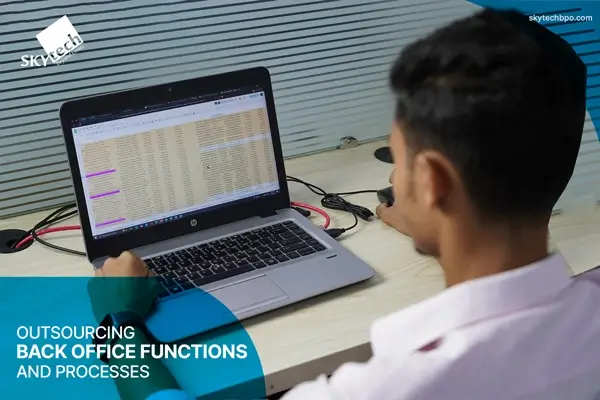
While back office support holds up the entire infrastructure of the business organization, its core functions drive success individually, working in unison. Every role the back office function plays, contributes to the overall growth and expansion as the front office charges ahead with unhindered vigor. While most go unnoticed, their unparalleled participation builds the foundation for the overall success that is just around the corner.
By exploring these back office functions, businesses can arm themselves with the knowledge of their importance, and better understand how back office support teams take charge. This also adds to the overall time and resources business organizations can refocus on revenue generation and global expansion.
Back office functions are core administrative tasks that keep a business running smoothly behind the scenes. These operations, while not being on the front lines, are integral roles that maintain efficiency and ensure that front office teams are supplied with every resource and data to keep their efforts trudging forward in full capacity. These are tasks that range from data entry and payroll to HR management and IT support, and form the foundation of a fully functioning business. We aim to bring these functions into light and explore their roles and effects in sheer detail to aid Entrepreneurs in making the right decision and helping their business reach the next level.

🔹General Administration
General Administration tasks that involve scheduling, office management, and document handling contribute heavily and uphold operational efficiency. These tasks might seem simple, but they keep all other processes working seamlessly. A flawless administrative process ensures that there is no room for error. Through selective outsourcing, you can delegate these tasks to seasoned professionals, allowing your in-house team to shift focus efficiently prioritizing revenue.
🔹Data Entry and Management
Business organizations are hot hubs for data accuracy, and keeping it all in check ensures how well they operate. This is all done through the core function of data entry and management, where expert back office staff are constantly mining and sorting data into legible info ready to be fed into the system. When outsourced, data related tasks gain an edge of smoothness, accuracy, and faster turnarounds for businesses looking to grow.
🔹Compliance and Regulatory Support
Keeping all processes and steps under the watchful scrutiny of regulatory institutions, back office functions need compliance and regulatory support teams that tackle every task related to smooth sailing for the business through calibrated directions. Not only do outsourced back office teams fulfill these functions, they also bring in the factors of expertise and standardization, guiding businesses through every obstacle set by governing bodies for fairness.
The administrative Support, while holding up the bridge, also cause massive strain on the organization’s resources, which often need a high amount of financing and management. Through outsourcing administrative tasks, entrepreneurs are able to better facilitate the core functions of businesses.
🔹Bookkeeping
All financial records need accurate bookkeeping, and this plays a vital role, in keeping every other process in check. This back office function provides a clear road to getting those numbers crunched with no errors. As it requires a very long chain of command and adept automation, the outsourced specialists are employed with the core prerequisites in mind that not only bring accuracy but also maintain compliance standards.
🔹Accounts Payable and Receivable
Processing the inflow and outflow of cash within a business is usually a daunting issue, and back office teams are always assigned as the first responders to recording and managing all these important fragments of data. With a clear picture of the cash flow, businesses make informed decisions based on accurate data. When outsourced, the friction is cut it quarters, getting the info to the decision makers on demand.
🔹Payroll Management
Businesses with a large number of employees require specialized back office teams adept at payroll management that keep the staff paid and looked after with special directives from HR. The tasks in payroll management cover every core function including payroll processing, tax filings, and benefits administration. With payroll outsourcing, businesses with large teams receive direct support without the sluggishness of continuous task delegation.
🔹Financial Reporting and Analysis
Every successful business organization relies heavily on Financial Reporting and Analysis to survive and succeed. Every vital decision requires the inclusion of reports on financial issues before it can reach a conclusion, and tasks like producing financial statements, budgeting, and financial analysis make that happen. To speed things up, outsourcing accounting services can reduce turnaround times, and provide trained hands, cutting down on costs and time.
Human resources maintain control and influence over the entire workforce, taking the responsibilities of recruitment, onboarding, and managing employee records and benefits while also managing their training and development. This helps create a bridge passing the chain of commands smoothly and effectively. If outsourced, it has the potential to allow organizations to reduce friction in their overall chain of command and reduce costs. While human resources serves a core function that manages the workforce, outsourcing human resources can speed up the process, giving companies an edge with saved time and resources.
🔹Recruitment and Onboarding
Businesses need constant monitoring and management when it comes to onboarding and recruiting able hands. While it may be a daunting task for the higher ups, the back office squads manage the entire process seamlessly through hiring procedures, employee onboarding strategies, and documentation. While these complex tasks are integrated into the system, outsourcing these functions can rapidly boost the process, eliminating roadblocks in every step, and setting up clear deadlines for turnover.
🔹Employee Records Management
Large business organizations usually struggle with keeping populated teams in check, and this goes on to further stifle all other processes if managed poorly. Keeping track of employee records, and managing their documents separately by able-bodied back office squads is what sets the tone and speed for their functionality. With outsourcing, this gets a huge boost, with complex tasks like maintaining accurate and up-to-date employee records and reporting to the management periodically seeing completion within set times.
🔹Benefits Administration
Back office teams also serve the function of managing the benefits including health insurance, retirement plans, and other perks employees receive during their tenure with business organizations. Such important tasks need constant upkeep and attention since they feed into the hands of employees who take the business forward. Having outsourced this, businesses can shift their focus on simply setting up a bridge between back office account teams, and the Benefits administration department to automate their processes seamlessly.
🔹Training and Development
Once on the team, companies need to take on the daunting task of organizing training programs and professional development opportunities for the new hires. Usually, this is managed and tackled by back office teams who serve this function beyond the call of duty. However, this is made much easier when outsourced to professionals who have the habit of training new recruits within half the time it would take in-house back office teams.
Companies need fully functional IT infrastructures to survive and thrive. These intricate systems are managed by back office squads looking into every aspect of tech support, making sure the infrastructure functions smoothly. Here are the core functions they serve throughout the IT department.
🔹System Maintenance and Updates
Companies require workstations that serve without interruptions, and it is usually up to back office tech support specialists to tackle system maintenance whenever required. Being on call, all throughout the day allows for quick fixes, keeping the work flowing seamlessly. Likewise, these teams also push for updates, installing them effortlessly throughout the network.
🔹Network Management
The local area network of a company serves as the veins through which data flows uninterrupted. Organizations must keep active back office IT support LAN admins to keep the network flowing free and troubleshoot any issues that pop up. Any interruption in the network can cause massive losses, therefore this function is extremely vital.
🔹Cybersecurity
While data breaches are a real threat, they require immediate action, as well as a front for active mitigation. This employs IT support teams to work around the clock setting up firewalls and gateway proxies, while also keeping up with data compliance, and encryption to provide an impregnable shield.
While IT support requires on-site presence, its power is never diminished when outsourced IT support is in play, which simplifies the process and adds much-needed expertise.
Companies operate under and adhere to a long list of laws and regulations that form the smaller grinding gears of the overall economy working in unison. Usually these laws are in place to kep businesses under regulatory scrutiny to enforce fair play. Back office teams have Legal and Compliance teams in place to make sure every legal issue is tackled with swiftness and accuracy.
🔹Contract Management
Contracts bind a company’s action in every step, bolstering their security and mitigating risks of fraud. Back office contract management teams lend their expertise in managing contracts, renewals, and legal documentation. This allows organizations to set up and manage contracts and vital paperwork. Outsourced contract management opens up the gates for qualified and certified individuals to handle these tasks right from the start, maneuvering gracefully through every contract.
🔹Regulatory Compliance
Businesses are bound by a web of industry-specific regulations designed to keep operations and processes in check. The role of back office compliance teams ensure all operations stay within the boundaries of these laws, preventing costly breaches. Staying compliant is non-negotiable, and these teams work quietly behind the scenes, keeping the company in line with every regulation. Outsourcing this process adds fluidity and much needed ease in managing regulatory compliance.
🔹Intellectual Property Management
Protecting a company’s trademarks, patents, and other intellectual assets is a function synonymous with back office legal teams that handle the registration, renewal, and management of all intellectual property. They also keep an eye out for any potential infringements, maintaining the company’s rights. Outsourcing this function gives businesses access to specialized legal experts who ensure the company’s creative assets are always protected, without needing to build an in-house team.
Supply Chain Management oversees the flow of goods and services from the company to the customer. It involves the functions of planning, sourcing, production, logistics, and delivery, optimizing the process along the way. Supply chain management done correctly also reduces costs, enhances quality, and improves customer satisfaction.
🔹Inventory Management
Inventory management keeps track of stocks, placing replenishment orders, and managing storage with accountability. Key roles of inventory management include maintaining optimal stock levels, avoiding overstocking or stockouts, and coordinating with suppliers to maintain smooth operations. Outsourcing inventory management provides specialized expertise, automates complex tracking systems, and improves accuracy, reducing risks.
🔹Vendor Management
Vendor management functions select suppliers, negotiate contracts, and maintain productive collaboration with vendors. It ensures that a business receives high-quality materials or services at the best possible terms. This back office function has major contributions in managing contracts, pricing, and service agreements. Outsourcing vendor management allows companies access to external expertise for more competitive pricing, risk management, and better supplier performance monitoring, saving cost and mitigating operational disruptions.
🔹Logistics and Distribution
🔹Logistics and distribution manage the transportation of goods from suppliers or warehouses to the delivery sites. It also includes shipping, freight management, and order fulfillment. This back office function is responsible for planning routes, selecting carriers, and ensuring timely delivery. Outsourcing logistics will provide access to a broader functioning network of carriers, increase delivery speed, and optimize shipping costs with standard practices. Outsourced logistics also allows businesses to scale distribution efforts more flexibly and efficiently, especially in global operations where complexity poses a significant challenge.
The back office plays a major role in holding up customer support operations with fresh data and statistics that feed into the overall effort in client satisfaction. Customer support operations include tasks that indirectly aid the impact of the front office involved with customer service through order processing, customer data management, billing and payment collections. With outsourced customer support operation functions, businesses can enjoy a faster flow for customer processing, and reduce operational friction along the way.
🔹Order Processing
Order processing involves managing the entire order fulfillment lifecycle, including order entry, tracking, shipping, and handling returns or exchanges. This back office function ensures that orders are processed efficiently, stock levels are accurate, and any customer requests for returns or replacements are handled smoothly. Outsourcing this function can provide faster turnaround times, improved tracking systems, and access to global logistics networks, providing smoother customer experiences.
🔹Customer Data Management
Accurate customer data is responsible for personalized service, marketing, and ensuring privacy and compliance with data protection laws. This back office function is tasked with collecting, updating, and securely storing customer information. Outsourcing customer data management to experts ensures companies follow data privacy regulations, access high-level security measures, and reduce the risk of data breaches while shifting focus to core business functions.
🔹Billing and Collections
Billing and collection back office departments create invoices, manage accounts receivables, process payments, and follow up on overdues. Billing and collections serve the purpose of maintaining cash flow and ensuring smooth financial operations. By outsourcing billing and collections, companies can automate processes, reduce errors, and improve payment tracking.
While marketing teams operate dealing directly with the production end, back office marketing support backs these teams up, creating a bridge of operations that streamline and guide the entire marketing effort. Marketing support manages entire campaigns tasked with handling data, research, market analysis, and content that empower successful campaigns and informed decision-making.
🔹Campaign Management
The back office teams assigned with campaign management are heavily involved in ensuring the smooth operations of every successful campaign through effective data analysis, reporting, and performance tracking of every involved front office staff. Gather customer and market data, they help identify target audiences and optimize campaigns. Reporting and insights provided by this back office function allow marketers to refine their strategies, optimizing ad spending and boosting ROI. Outsourcing campaign management enables businesses the access to specialized expertise in data handling and analytics ensuring marketing teams stay focused on creative aspects.
🔹Content Management
Managing marketing content consistently involves maintaining websites, updating social media channels, and creating promotional materials. This function ensures content remains consistent, up-to-date, and aligned with the brand. By outsourcing back office content management, businesses will speed up content delivery, minimize errors, and empower their front office teams to focus on creative development instead of repetitive management tasks.
🔹Market Research and Analysis
Market research and analysis teams collect and evaluate market trends, consumer behavior, and competitor strategies to influence business decisions in the right direction. The back office gathers and processes large sets of data, generating insights that help businesses identify opportunities, mitigate risks, and make informed strategic decisions. Outsourcing market research can provide access to more advanced research tools, reduce the time spent on data collection, and deliver comprehensive reports that guide marketing strategies more effectively.
Procurement teams maintain a business’s operational efficiency, ensuring the right goods and services are acquired right when they’re needed. This back office function manages these processes, from sourcing to asset management. Outsourcing procurement enables companies to streamline their entire process, and boil down turnover times in half.
🔹Sourcing and Purchasing
Sourcing and purchasing back office teams are solely responsible for sourcing suppliers, negotiating contracts, and purchasing goods and services to keep business processes flowing smoothly. They are tasked with identifying potential vendors, evaluating their offerings, and ensuring compliance with company standards and policies. Purchasing ensures goods and services are acquired within budget and delivered on time. Outsourcing sourcing and purchasing tasks help businesses tap into global supply networks, save costs, and shift focus to core functions.
🔹Inventory and Asset Management
Inventory and asset management functions by tracking and managing the company’s physical assets and inventory, including acquisition and disposal. This includes ensuring optimal stock levels, monitoring depreciation, and overseeing asset utilization. Through outsourcing, this function enables businesses to utilize advanced inventory tracking systems, minimize waste, and ensure proper handling and disposal of assets, consequently reducing costs and improving efficiency.
Quality assurance back office function maintains the integrity and efficiency of business operations. This also ensures that processes comply with established standards, go beyond the status quo with improved practices and continuously evolve to enhance performance. QA is usually outsourced to get a hold of more efficient standards in maintaining and improving quality.
🔹Process Audits and Reviews
This back office function conducts regular process audits to ensure compliance with internal and external standards. These necessary audits involve reviewing workflow, procedures, and outputs to identify discrepancies or inefficiencies that need immediate action. Through consistent audits, back office teams mitigate risks, maintain quality control, and ensure smooth operations. Outsourcing this back office function allows companies to benefit from specialized auditors bringing in fresh perspectives and advanced knowledge of compliance standards.
🔹Continuous Improvement Initiatives
Specialized Back office teams are employed to identify opportunities for process optimization by analyzing performance metrics, gathering feedback, and observing operational bottlenecks. This function collaborates with departments to implement changes that improve efficiency, reduce costs, and enhance service quality. Outsourcing continuous improvement tasks enable companies to tap into expert methodologies like Lean, Six Sigma, and other performance optimization frameworks, ensuring that the company constantly evolves and remains competitive.
Research and development back office teams are a vital asset to companies looking to expand their borders. These teams are constantly sifting through vast quantities of data, and help outline newer innovations that can pave the way for growth and expansion. When outsourced, the R&D department can fill positions with qualified and certified individuals with a unique perspective of the market.
🔹Data Collection and Analysis
Back office teams handle data collection and analysis tasks that enable the business to switch gears and align their efforts with improved practices. The core function involves collecting data, and analyzing them to provide businesses with the right approach in improving their products and services. When outsourced to professionals, businesses are empowered with expert teams that bring value and automation to the entire process.
🔹Documentation and Reporting
Back office teams involved in documentation and reporting manage paperwork, technical documents, and reports related to research activities, including regulatory submissions, patent filings, and internal reporting. The experts in this field ensure the documentation is properly formatted, stored, and accessible when needed, which is essential for regulatory compliance and intellectual property protection. Outsourcing this function will streamline documentation management, ensuring that all regulatory and legal standards are met with effectiveness.

Optimizing back office functions involve process improvement, automation, technology integration and outsourcing. While businesses can adopt and employ better practices, eventually investing in back office teams takes up resources that can otherwise help core business processes.
🔹Process Improvement
Process improvement can optimize back office functions, and improve turnover times. This involves evaluating and testing applied methods that aim to rectify errors in current departments. Process improvement itself involves the role of another back office function, and can usually be sluggish if done incorrectly and ineffectively.
🔹Automation and Technology Integration
While automation unrolls its influence on the main stage, it has become a vital aspect of optimizing back office functions. Through the implementation of automation and technology integration, companies can improve and optimize their processes, but this itself becomes slowed due to the training and procurement for these essential automation tools.
🔹Outsourcing Back Office Functions
Outsourcing back office functions is the most widely used methods business organizations use to optimize their overall back office functionality. With expertise, automation, technology, and the freeing up of resources, companies enjoy a burst of time and energy on core competencies that propel the entire organization forward on its goal to growth and expansion. It is obvious from the evidence that successful organizations such as Microsoft & Apple outsource their back office tasks, and enjoy a powerful concentration of efforts and resources into their primary functions.

A BPO, or business process outsourcing firms rely on teams of experts employed to provide exceptional back office support to offshore business organizations. Through a wide array of back office support services being outsourced, BPOs provide companies with the opportunity to grow and expand effectively, reducing organizational friction, and saving costs, while also ensuring smooth scalability along the way.
SkyTech Solutions, a giant in the outsourcing industry has adapted to global practices, delivering consistent results for countless business organizations worldwide, including the eCommerce giant AliBaba. With expertise serving growing businesses, SkyTech Solution stands as a frontier for organizational growth through effective outsourcing. Outsourcing your business processes is only a consultation call away, and a wide array of back office support tasks will ensure that you’ll find the best pick for your business. Back office functions play a major role in catapulting businesses to the next level, and getting started right away is the only obstacle stopping businesses from unleashing their potential to become successful.

Sales organization and business process outsourcing specialist with over 15 years experience in building and running highly efficient sales and customer support organizations, and in providing board and project level consulting to the sales and service organizations of leading companies all over the globe. Developed and implemented staffing strategies and programs that improved operational outcomes and maximized the available staff resources. Specializes in client experience, business process re-engineering, business requirements development, contact center optimization, customer relationship Management, staff training and motivation, and organizational analysis. Has led multiple teams in the successful development and implementation of new business models in BPO industries.
 BD (Head office):
 USA:
USA:
 Aus:
Aus:
 UAE:
UAE: