
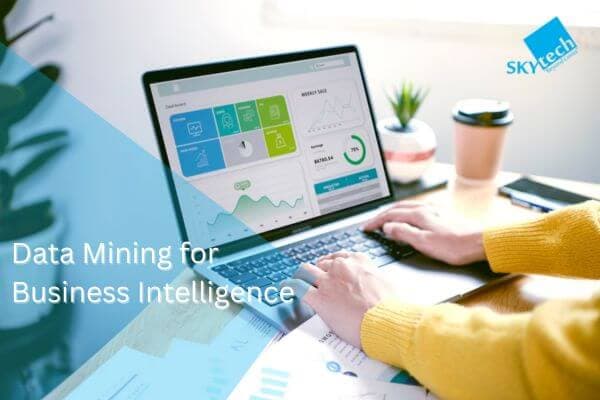
In the ever-evolving landscape of today’s data-centric business world, staying ahead requires more than just collecting vast amounts of information.
As a seasoned professional in the field of data mining and business intelligence, we understand the critical role data mining plays in extracting valuable insights from massive datasets.
Here, we will come up with the following:
✔ What is Data Mining?
✔ What is Business Intelligence?
✔ Key Differences Between Data Mining and Business Intelligence
✔ How Data Mining Helps Business Intelligence?

The technique of collecting key information, patterns, and trends from a huge dataset has been known as data mining.
By adopting different statistical, mathematical, and machine learning methods, data is examined and understood to identify hidden information that may not be noticeable utilizing more conventional methods.
Business Intelligence (BI) is the strategic transformation of raw data into actionable insights. It relies on software and services to turn data into intelligence, shaping decisions based on facts, not assumptions.
BI tools provide detailed reports, dashboards, and charts, influencing strategic, tactical, and operational decisions.
Let us look at the differences between data mining and business intelligence.
| Feature | Data Mining | Business Intelligence |
| Purpose | Extract data for problem-solving | Visualize and present data to stakeholders |
| Volume | Analyze data sets for focused insights | Analyze relational databases for organizational insights |
| Result | Utilize unique, usable data formats | Create dashboards, charts, graphs, histograms, and more |
| Focus | Emphasize key performance indicators | Track progress on KPIs |
| Tools | DataMelt, Orange, R, Python, and Rattle GUI | Sisense, Power BI, SAP for BI, Dundas BI, Tableau |

Data mining is the cornerstone of business intelligence, unraveling hidden patterns and trends within vast datasets. It empowers informed decision-making, providing a competitive edge in the dynamic landscape of modern business.
Here are some significant roles that data mining performs in business intelligence to make a business stay on top.
The ability of data mining to identify patterns and trends in massive amounts of data is one of its primary contributions to business intelligence. Businesses generate massive amounts of data throughout processes, and undetected in this deluge of data are useful pearls of knowledge.
This data is processed using data mining methods, which show relationships, trends, and correlations that could have been ignored. For instance, retail firms may utilize data mining to analyze previous purchases made by their clients and observe trends in their purchasing patterns.
Considering this data, promotional strategies can be more successfully personalized, customer demand can be properly predicted, and merchandise placement may be improved.
Predictive statistical analysis is an effective tool utilized by companies for predicting future trends and outcomes, which has been made possible by data mining. Companies can develop algorithms to predict potential patterns or activities by looking at previous information, which allows them to take early actions in decision-making processes.
This can be particularly useful for inventory optimization, risk management, and sales forecasting operations. For example, data mining data mining is commonly utilized by financial companies to assess past market data and predict potential risks or possibilities of investments. Due to these predicting insights, businesses may increase revenue and reduce risks by modifying their plans in real-time.

Businesses seeking ways to modify services and products according to specific requirements need to have an in-depth knowledge of how customers behave. Customer segmentation is a method for categorizing clients based on common attributes, and data mining simplifies this procedure.
Companies can personalize customer satisfaction, product suggestions, and marketing campaigns because of this segmentation. Data mining is frequently implemented in e-commerce online stores to investigate customer tastes, buying patterns, and demographic information.
Businesses may enhance customer satisfaction and loyalty by establishing customized suggestions and specialized marketing strategies based on an understanding of each of these variables.
Prevention of risks and fraud detection are vital missions in fields such as finance and insurance. Since it can identify anomalies and trends related to fraudulent activity, data mining is highly significant in these scenarios. By investigating transactional information and customer habits, businesses may develop algorithms that immediately recognize doubtful activities.
Example: Visa and MasterCard companies rely on data mining techniques to identify unusual spending patterns, which could hint at unauthorized purchases. Despite protecting businesses from financial losses, this preventative approach keeps their customers’ trust and belief in them.
Besides boosting operational effectiveness, data mining can also maximize internal procedures. Companies may locate obstacles, speed up operations, and improve efficiency by reviewing operational-related data evaluations.
Cost savings and a structure for the organization that is more adaptable and responsive follow from this. Supply chain management is a field in which data mining could significantly affect.
Companies may improve their supply chain management procedures, lowering expenses and speeding up shipping times through the analysis of data related to inventory levels, supplier quality, and logistics.

Companies often combine data mining with specialized business intelligence (BI) tools to maximize the advantages of data mining. These tools provide a straightforward interface for observing and evaluating data mining outcomes.
Company researchers may create dynamic visualizations and reports to improve decision-makers understanding and implementation of the valuable perspective gained through data mining.
The tools used for data mining can be quickly integrated using renowned BI tools like Tableau, Power BI, and Qlik Sense, which allows businesses to analyze their information and gather useful insights.
The combination of information makes it less difficult for people to make decisions by offering complex data analysis in an approach that is easy for anyone to understand.
In conclusion, a key aspect of current business analysis of data mining allows businesses the capacity to extract useful data from huge and complex datasets. Data mining makes it possible for companies to make smart choices, simplify activities, and surpass competitors by identifying hidden patterns and predicting trends in the future.
The relationship between business intelligence and data mining will undoubtedly be significant for assessing the performance of businesses within a range of industries to explore the data-driven era.

Sales organization and business process outsourcing specialist with over 15 years experience in building and running highly efficient sales and customer support organizations, and in providing board and project level consulting to the sales and service organizations of leading companies all over the globe. Developed and implemented staffing strategies and programs that improved operational.
Natore Tower (12th Floor), Plot no 32D & E, Road 2, Sector 3, Uttara Model Town, Dhaka- 1230, Bangladesh